
Peyronie’s disease (acquired penile curvature)
Penile curvature caused by the formation of fibrous plaque in the tunica albuginea is more common than one might think. Contrary to appearances, it is not a rare problem — it occurs in a significant proportion of men, most often after the age of 50, although it can also appear earlier.
Prevalence of Peyronie’s disease
Causes and risk factors of Peyronie’s disease
Peyronie’s disease is a complex condition whose development depends on many overlapping factors. Although medicine is gaining a better understanding of its course and mechanisms, there is still no clear answer as to why some men develop fibrous plaque and penile deformity and others do not.
The cause of Peyronie’s disease remains unknown. It is suspected that microtrauma to the tunica albuginea is at the root of the problem, but it is not known why in some men it heals without a trace, while in others it leads to plaque formation and curvature. It is also impossible to predict how large the plaque will be or how severe the curvature will be.
Risk factors
It is assumed that the development of the disease may be influenced by, among other things:
However, it is impossible to predict with certainty who will develop penile curvature and to what extent.
Diagnosis
During the visit, the doctor will conduct a thorough interview, measure the length of the penis and assess the size and position of the plate.
Photographs of the erect penis (from above and from the side) are much more useful for diagnosis than most imaging tests.
Tests such as ultrasound of the flaccid penis, magnetic resonance imaging or computed tomography are not relevant in this case. Alternatively, it may be worth performing a Doppler ultrasound of the penis in artificial erection.
Stages of Peyronie’s disease – From pain to deformity
Active phase
In the first phase, pain occurs during erection and intercourse, as well as a hard thickening in the penis. During this period, gradual deformation of the penis occurs.
Stable phase
After about 12 months, the plaque becomes hard and inflexible, sometimes even calcified. The penis then reaches its final shape and degree of curvature.
Spontaneous improvement may occur in approximately 13% of patients, but in the majority (52–94%) the curvature persists.
Treatment of Peyronie’s disease: what you need to know
The treatment of Peyronie’s disease depends on its stage and severity. In the initial stage, it focuses on pain relief and slowing down the changes, while in the stable phase, surgical treatment is possible. It is also worth knowing which methods of therapy actually work and which, despite their popularity, do not bring the expected results.
Treatment in the active stage
The aim of therapy at this stage is to relieve pain and slow down the progression of the disease.



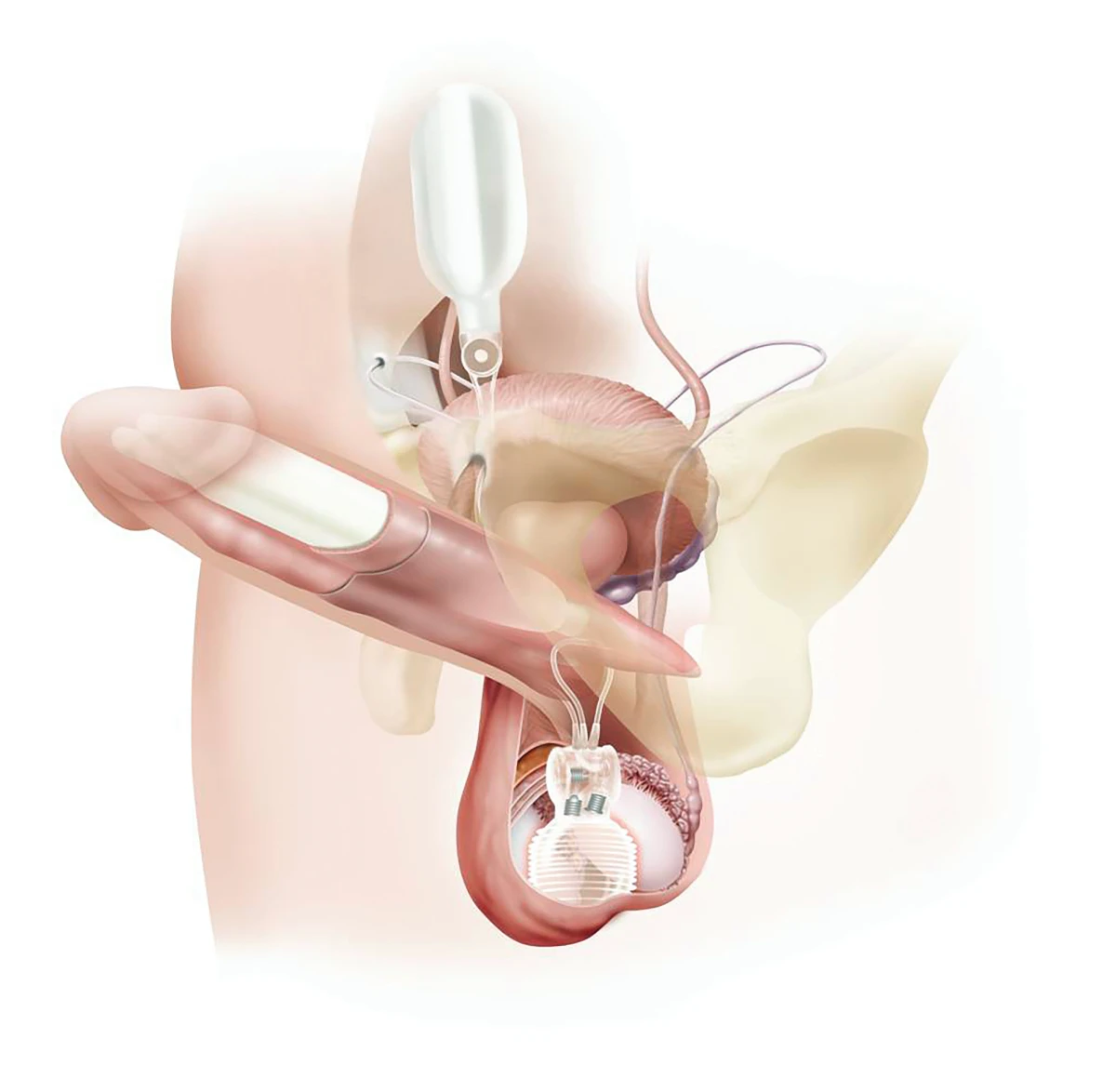
Treatment in the stable phase
When the pain subsides and the curvature does not worsen for at least 3 months, the disease is considered to have entered a stable phase. At this stage, surgical treatment is possible.
The following factors are taken into account:
The aim of the operation is to achieve a functional penis capable of sexual intercourse – not always perfectly straight or aesthetically pleasing.
Types of surgery
However, it should be remembered that the implant does not lengthen the penis – it maintains its length from the day of the procedure, restoring full functionality and a straight shape.
Effective and ineffective treatment methods
The only drug that has been proven effective in reducing curvature and plaque size is collagenase (from Clostridium histolyticum bacteria) – currently unavailable in Europe. A similar effect can be achieved with Interferon alfa-2b administered intraplaque.
Ineffective methods